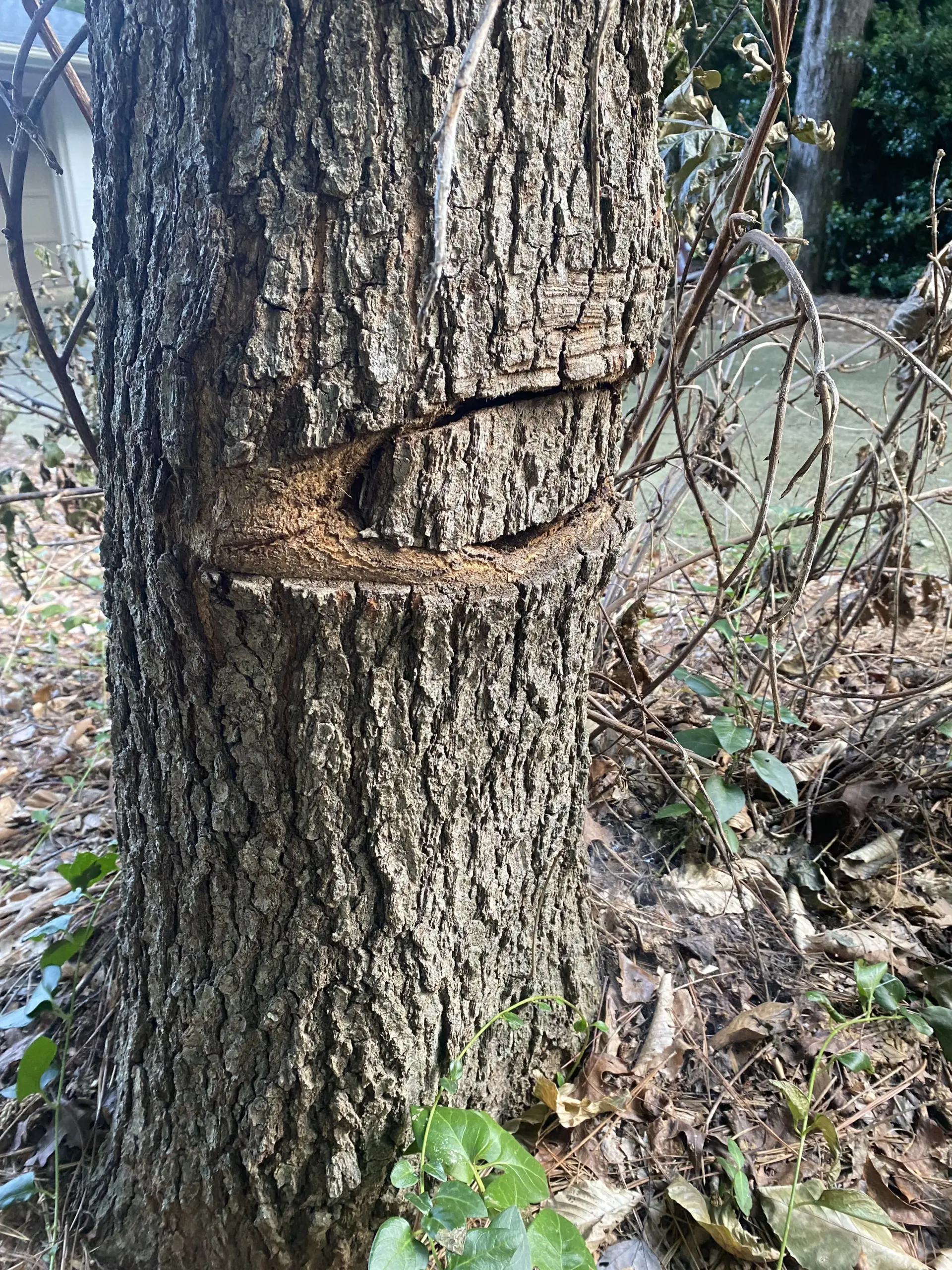
A tree risk assessment is a professional inspection that tells you how likely a tree is to fail, what it would hit if it did, and what to do about it. NC Trees and More performs tree risk assessments across Raleigh, Durham, Chapel Hill and the Triangle using the ISA Tree Risk Assessment Qualification method, known as TRAQ, the standard method used by professional arborists.
You get a clear risk rating for each tree and a plain-language plan: keep it, prune it, treat it, monitor it or remove it. No guesswork, and no removing healthy trees that only look worrying.
Triangle homeowners call us when a big willow oak leans toward the house, a loblolly pine starts dropping limbs, a storm leaves a tree cracked, or a home sale, HOA or insurance claim needs a written opinion from a qualified arborist.
Call or text 984-254-6912, 24 hours a day, or request a free estimate online.
What Is a TRAQ Tree Risk Assessment?
TRAQ stands for Tree Risk Assessment Qualification, a credential from the International Society of Arboriculture. Arborists who hold it follow one consistent method, based on the ANSI A300 standard for tree risk assessment, so the result is a documented professional judgment rather than an opinion. Every assessment answers three questions.
Likelihood of Failure
Is the tree, or part of it, likely to break, uproot or drop a limb within a given time frame? The arborist looks for decay, cracks, weak branch unions, root damage and dead wood.
Likelihood of Impact
If the tree fails, will it strike something that matters? Targets include your roof, driveway, deck, play areas, vehicles, sidewalks and power lines, along with how often people spend time beneath the tree.
Consequences of Failure
How serious would the damage be? A small limb falling on an open lawn is very different from a large trunk falling on a bedroom.
What Every Assessment Includes
- An inspection by an ISA Certified Arborist trained in the TRAQ method
- Identification of hazards such as structural weaknesses, decay, root problems and disease
- A risk rating for each tree assessed
- A tailored management plan to reduce the risks we find
- Recommendations that protect your property and keep healthy trees standing for years
The Three Levels of Tree Risk Assessment
Not every tree needs the same depth of inspection. The TRAQ method defines three levels, and we recommend the one that fits your situation.
Level 1 Limited Visual Assessment
A quick visual check, often covering many trees, to spot obvious defects. It suits large lots, HOA common areas, roadside trees and utility corridors where the goal is to find the trees that need a closer look.
Level 2 Basic Assessment
A detailed ground-level inspection of a single tree from every side, using simple tools such as a sounding mallet, probe and binoculars. This is the right level for most residential trees near homes, driveways and play areas.
Level 3 Advanced Assessment
Specialized testing such as resistance drilling, sonic tomography, root collar excavation or an aerial climbing inspection. It is used for large, valuable or heritage trees when hidden decay must be measured before deciding whether to keep or remove the tree.
How Our Tree Risk Assessment Process Works
Step 1: Tell Us Your Concern
Call or text 984-254-6912 and describe the tree, where it stands and what worries you. Photos help us prepare.
Step 2: On-Site Tree Inspection
Our arborist examines the roots, root flare, trunk, branch unions and canopy, and notes everything within striking distance.
Step 3: Site and Target Review
We look at soil conditions, grade changes, recent construction, drainage and how often people use the area under the tree.
Step 4: Risk Rating
Each tree receives a rating of Low, Moderate, High or Extreme based on the TRAQ method.
Step 5: Your Management Plan
We walk you through the findings and give you clear options, from monitoring the tree to pruning, cabling or removal. A written report is available when you need documentation.
Understanding Your Tree Risk Rating
Low Risk
Failure is unlikely, or would cause little harm if it happened. The tree can stay and be checked during routine care.
Moderate Risk
There is some risk worth managing over time. Corrective pruning, plant health care or a scheduled reinspection usually keeps it under control.
High Risk
Failure is probable and would strike something valuable. Act soon with targeted pruning, cabling and bracing, or removal.
Extreme Risk
Failure is imminent and likely to cause serious harm. Keep people and vehicles away from the tree and act immediately.
Most of the time, risk can be lowered without taking the tree down. Reducing heavy limbs over a roof, removing deadwood or improving soil and root health through plant health care often brings a tree back into an acceptable range. When tree removal is the safer choice, we explain why before any work is scheduled.
Why Triangle Properties Need Tree Risk Assessments
Raleigh is known as the City of Oaks for good reason. Older neighborhoods such as Oakwood, Five Points and Hayes Barton in Raleigh, and Trinity Park, Forest Hills and Hope Valley in Durham, are shaded by willow oaks, red oaks and tulip poplars that are many decades old. Big, mature trees add value to a property, but age brings decay, weak branch unions and heavy limbs over roofs. Local conditions add to the risk.
Piedmont Red Clay
Much of the Triangle sits on dense clay that drains slowly. Saturated clay loosens its grip on roots, which is why trees often uproot when heavy rain is followed by strong wind.
Storms and Ice
Summer thunderstorms, tropical storm remnants and winter ice put sudden loads on limbs. Many residents still remember the damage from Hurricane Fran in 1996 and the December 2002 ice storm.
Tall Loblolly Pines
Loblolly pines are common on Triangle lots. Root damage and bark beetles can weaken them, and their height puts nearby homes within reach.
Construction Root Damage
Rapid growth in Apex, Cary, Wake Forest and Morrisville means trenching, grading and soil compaction near existing trees. Root damage from construction can take several years to show in the canopy, long after the risk has begun.
Drought Stress and Disease
Dry summers stress oaks and open the door to problems such as hypoxylon canker, which decays wood from the inside while the tree may still look green.
What a Typical Assessment Looks Like
Consider a common situation in an established Durham neighborhood. A homeowner notices mushrooms at the base of a large willow oak that leans toward the back deck, and a neighbor suggests taking it down.
During a Level 2 assessment, the arborist sounds the trunk, probes the root flare and checks the canopy. The fungal growth points to some root decay on one side, but the trunk is solid and the lean is old and stable. The real concern turns out to be two heavy limbs extending over the deck.
In a case like this, the tree is often rated Moderate. The plan is to reduce the two limbs, mulch and protect the root zone, and reinspect on a set schedule. The homeowner keeps a shade tree that would take decades to replace, and the risk over the deck drops.
Tree Risk Do’s and Don’ts for Homeowners
Do
- Look over your large trees after every major storm and note any new cracks, leaning or hanging limbs
- Mulch the root zone, keeping mulch pulled back from the trunk
- Fence off the area under the canopy before any construction, trenching or driveway work
- Have mature trees near your home or play areas inspected on a regular schedule
- Get a written assessment before buying or selling a property with large trees
- Call an ISA Certified Arborist as soon as you see warning signs
Don’t
- Don’t top trees; it creates weak regrowth that breaks more easily in storms
- Don’t try to prune or remove limbs near power lines yourself
- Don’t pile soil, park vehicles or store heavy materials over tree roots
- Don’t ignore mushrooms, conks or oozing at the base of a tree
- Don’t remove a tree only because it leans; many leans are stable
- Don’t hire crews without proof of insurance and a certified arborist on staff
Signs a Tree Needs a Risk Assessment
Call for an assessment if you notice any of these warning signs:
- A new or increasing lean, especially with cracked or lifted soil on the opposite side
- Mushrooms, conks or other fungal growth on the trunk or around the base
- Cracks, splits or cavities in the trunk or major limbs
- Dead or hanging branches in the upper canopy
- V-shaped trunk unions with bark pressed between the stems
- Thinning leaves, early leaf drop or dieback at the top of the tree
- Recent construction, trenching or grade changes within the root zone
- Storm damage, even if the tree still looks mostly intact
If a tree is actively cracking, leaning onto a structure or touching power lines, do not wait for an assessment. Call our 24/7 emergency tree service line at 984-254-6912.
Who Needs a Tree Risk Assessment?
Homeowners
If you have large trees near the house, driveway, deck or play areas, an assessment tells you which ones are sound and which need attention.
Home Buyers and Sellers
An assessment before closing shows what you are taking on, or gives buyers confidence in the trees on the lot you are selling.
HOAs and Property Managers
Communities are responsible for trees in common areas, along walkways and near shared structures. Regular assessments support documented, defensible maintenance decisions.
Commercial Properties, Churches and Schools
Where many people pass under trees every day, knowing the risk level of each tree is part of keeping visitors safe.
Neighbors and Insurance Claims
An independent assessment can help settle concerns about a tree near a shared property line, or respond to an insurer’s request about a tree’s condition.
What Affects the Cost of a Tree Risk Assessment?
Every estimate is based on the work your property actually needs. We explain what is included before we start, so there are no surprises.
Number of Trees
One tree near the house takes less time than a wooded lot or an HOA tree inventory.
Level of Assessment
A Level 1 visual check takes far less time than a Level 3 advanced inspection with specialized equipment.
Tree Size and Site Access
Large trees, steep slopes and tight backyards take longer to inspect thoroughly.
Written Report
A documented report for an insurer, HOA, real estate transaction or municipality takes additional time to prepare.
Urgency
Storm-related or same-day requests may affect scheduling.
Why Property Owners Choose NC Trees and More
ISA Certified Arborist With TRAQ Training
Your assessment follows the recognized industry method, not a quick glance from a crew looking to sell a removal.
Removal Only When It Is the Right Call
Our focus is prescription pruning and low-impact tree care that keeps healthy trees standing.
One Team From Assessment to Completion
If the plan calls for tree pruning, cabling, plant health care or removal, the same team that assessed the tree can carry out the work.
$2 Million General Liability Coverage
We are fully insured for work at height, and our crew is trained to ANSI and OSHA standards with wireless communication on every job site.
Locally Owned in Durham
We know Triangle soils, tree species and storm patterns firsthand, and we offer senior and military discounts on qualifying work.
Tree Risk Assessments Across the Triangle
From our base on Coley Road in Durham, we provide tree risk assessments in Durham, Raleigh, Chapel Hill, Cary, Apex, Morrisville and Wake Forest, along with Hillsborough, Bahama, Butner, Creedmoor and communities throughout Wake County.
Tree Risk Assessment FAQs
What is a TRAQ arborist?
A TRAQ arborist is an ISA Certified Arborist who has also earned the ISA Tree Risk Assessment Qualification. It shows they are trained in the industry’s standard method for rating tree risk and recommending ways to reduce it.
How long does a tree risk assessment take?
A basic assessment of one or two trees usually takes under an hour on site. Larger properties, multiple trees or Level 3 advanced testing take longer, and written reports are prepared after the visit.
Can a tree risk assessment save a tree from removal?
Yes. Many trees that look dangerous can be made safer with targeted pruning, cabling or improved root care. An assessment shows whether the tree can be kept and what it would take.
Do I need a tree risk assessment before removing a tree?
Not always, but it is the best way to know whether removal is necessary. Some HOAs, property managers and municipalities may also ask for an arborist’s documentation before approving removal of a large tree.
How often should trees be assessed?
Mature trees near homes or high-use areas benefit from regular inspections, and any tree should be checked after major storm damage, nearby construction or a visible change such as a new lean or fungal growth. Your arborist will recommend a reinspection interval based on the risk rating.
Will a tree risk assessment help with insurance or a home sale?
A written assessment from a qualified arborist documents a tree’s condition on a specific date. That record can be useful for insurers, buyers, sellers and HOAs. Ask your insurer or agent what documentation they require.
Get a Clear Answer About Your Trees
A large tree near your home is either an asset or a liability, and you should not have to guess which. A tree risk assessment from an ISA Certified Arborist gives you a documented rating and a practical plan, so you can keep the trees that are sound and deal with the ones that are not before the next storm tests them.
Call or text NC Trees and More at 984-254-6912, 24 hours a day, 7 days a week, or request your free estimate online.